
How Soil pH Affects Your Lawn (And When to Use Lime)
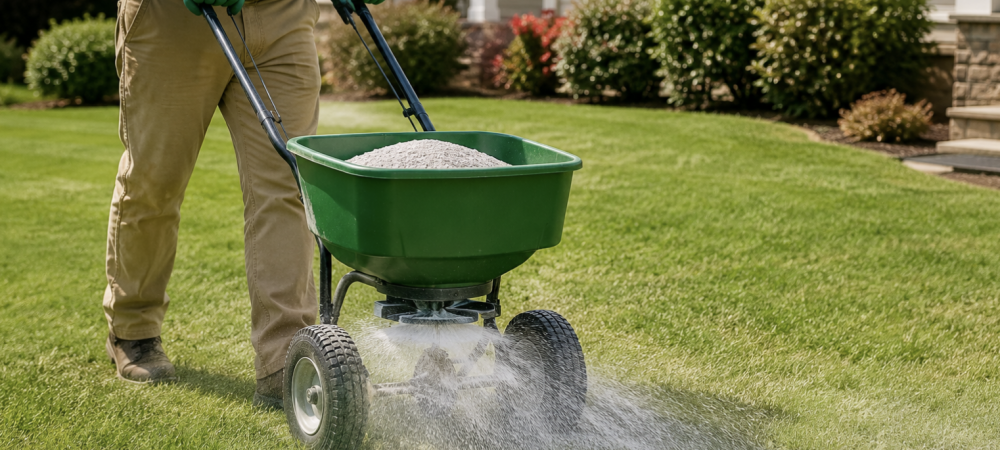
You can fertilize on schedule all season and still end up with thin, yellow grass. If the soil pH is off, your lawn cannot absorb the nutrients already in the ground.
Fast Facts
- Most cool-season grasses perform best at a soil pH between 6.0 and 7.0. Below that, nutrients become unavailable even when you fertilize regularly.
- A soil test is the only reliable way to confirm low pH is actually the problem.
- Lime raises soil pH gradually. It is not a fertilizer and should not be applied without a test confirming it is needed.
How Soil pH Affects Your Grass
Soil pH is measured on a scale from 0 to 14. A reading of 7.0 is neutral. Below that is acidic, above is alkaline. Cool-season grasses like Kentucky bluegrass, tall fescue, and perennial ryegrass do best between 6.0 and 7.0, with 6.5 as the general target.
When pH drops below that range, essential nutrients including nitrogen, phosphorus, potassium, and calcium bind to soil particles and become chemically unavailable to grass roots. Penn State Extension identifies soil pH as the single greatest factor controlling nutrient availability in most lawn soils. This is why lawns with chronically low pH often look like they have a fertilizer problem when the actual issue is that the fertilizer cannot work.
Signs Your Lawn May Have a pH Problem
- Persistent yellowing or pale grass that does not respond to fertilizer
- Thin turf that struggles to fill in despite regular care
- Moss growth, particularly in shaded or moist areas
- Increasing weeds, especially dandelions and plantain, which tolerate acidic soil
- Slow recovery from drought or heavy use
These symptoms overlap with other lawn problems, which is why treating for pH without testing first often produces no results. A professional soil test gives you a confirmed reading and a specific lime recommendation for your soil type.
What Lime Does (and What It Does Not Do)
Lime is made from ground limestone and contains calcium carbonate. When applied to acidic soil, it neutralizes hydrogen ions and raises pH back toward the target range. As pH improves, the nutrients that were chemically locked in the soil become available again and fertilizer starts working the way it should.
Lime is not a fertilizer. It does not feed grass directly. Its job is to correct the chemical environment so everything else in your lawn care program can function. Over-applying lime pushes pH too high and creates a different set of nutrient deficiencies, which is why testing before application matters.
When to Apply Lime
Fall is the best time. Rainfall and freeze-thaw cycles through winter help break lime down into the soil before spring green-up. Early spring works as a second option if fall was missed. Avoid applying during summer heat stress or to frozen ground, where lime will sit on the surface and do nothing.
Lime works slowly. Most lawns see pH begin to shift within three to six months. Retest six months after application before adding more. If aeration is already on your schedule, it's worth asking your technicians if applying lime right after could help it reach the root zone faster.
Does Your Lawn Actually Need Lime?
Not every lawn does. The advice to lime every year is oversimplified. If pH is already in the 6.0 to 7.0 range, adding lime will push it too high and cause new problems. Lawns that have been fertilized consistently for several years without pH monitoring, particularly in the Mid-Atlantic and Northeast where soils tend to acidify faster due to rainfall and lower natural calcium levels, are the most common candidates.
A well-designed lawn care program accounts for soil chemistry alongside fertilization and weed control. If your lawn has not responded the way you expected to standard care, a soil test is the right starting point. WeedX Fertilizing includes soil testing as part of its lawn care program. Request a free estimate to find out what your soil actually needs.